
How to Measure the Elevation of the Moon
Method 1: Use a DIY Inclinometer
Materials:
- Standard protractor
- Disposable straw or otherwise narrow tube
- String (about 6-8 inches long)
- Two medium binder clips
- Small but relatively heavy weight (e.g., a metal washer or nut)
Assembly Instructions:
- Tie one end of the string securely to the weight to create a “plumb bob.”
- Thread the other end of the string through the hole at the center of the straight edge of the protractor.
- If your protractor doesn’t have a hole, carefully make one or tape the string so it hangs from the center.
- Attach the straw to the flat edge of the protractor using the binder clips.
- Trim the straw so it doesn’t extend beyond the protractor’s length.
How to Use Your Inclinometer:
- Go outside where you can clearly see the moon.
- Hold the inclinometer up to your eye and look through one end of the straw to sight the moon.
- Let the plumb bob hang freely and steady.
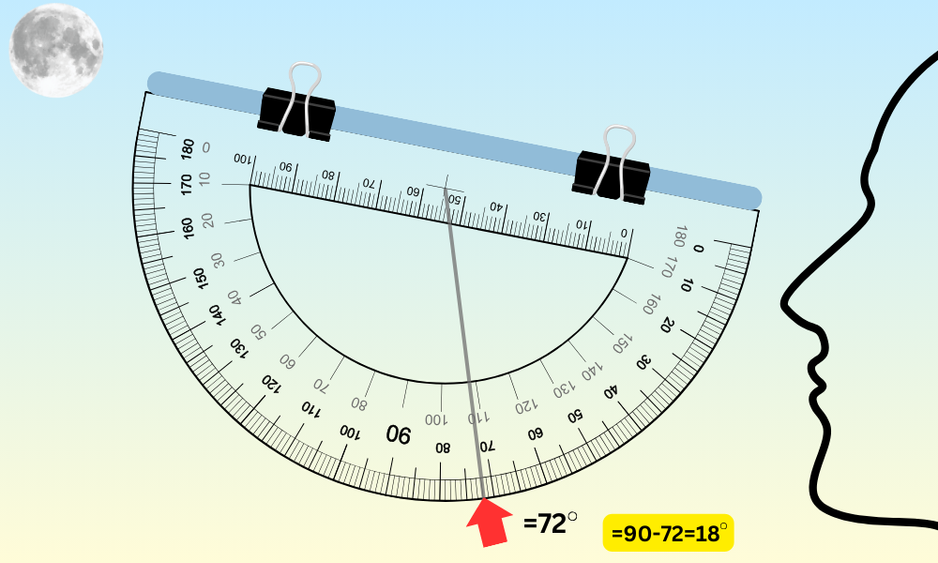
- Once you have a steady view of the moon and the string has stopped swinging, gently clamp your finger against the string where it crosses the curved edge of the protractor to hold it in place.
- Read the angle measurement (from 1 to 90°) where you have clamped the string on the protractor’s scale.
- Subtract that number from 90° to calculate the elevation angle of the moon.
Method 2: Use the USNO website (U.S. Naval Observatory Data Services)
- Go to: https://aa.usno.navy.mil/data/AltAz
- For Object, select “Moon“
- Enter the date
- Enter a Tabular Interval of 5 minutes (default is 10 minutes)
- Enter your location using Latitude/Longitude or click “Need USA Location?”
- Your time zone will automatically be loaded into the Time Zone field but you can change this if needed.
- Click “Get Data“
A table showing the moon’s “Altitude” (or elevation) is shown for every 5 minutes throughout the day in military time, except for when the Moon is below the horizon). Choose the time interval closest to your observation time and note the Altitude reading.